

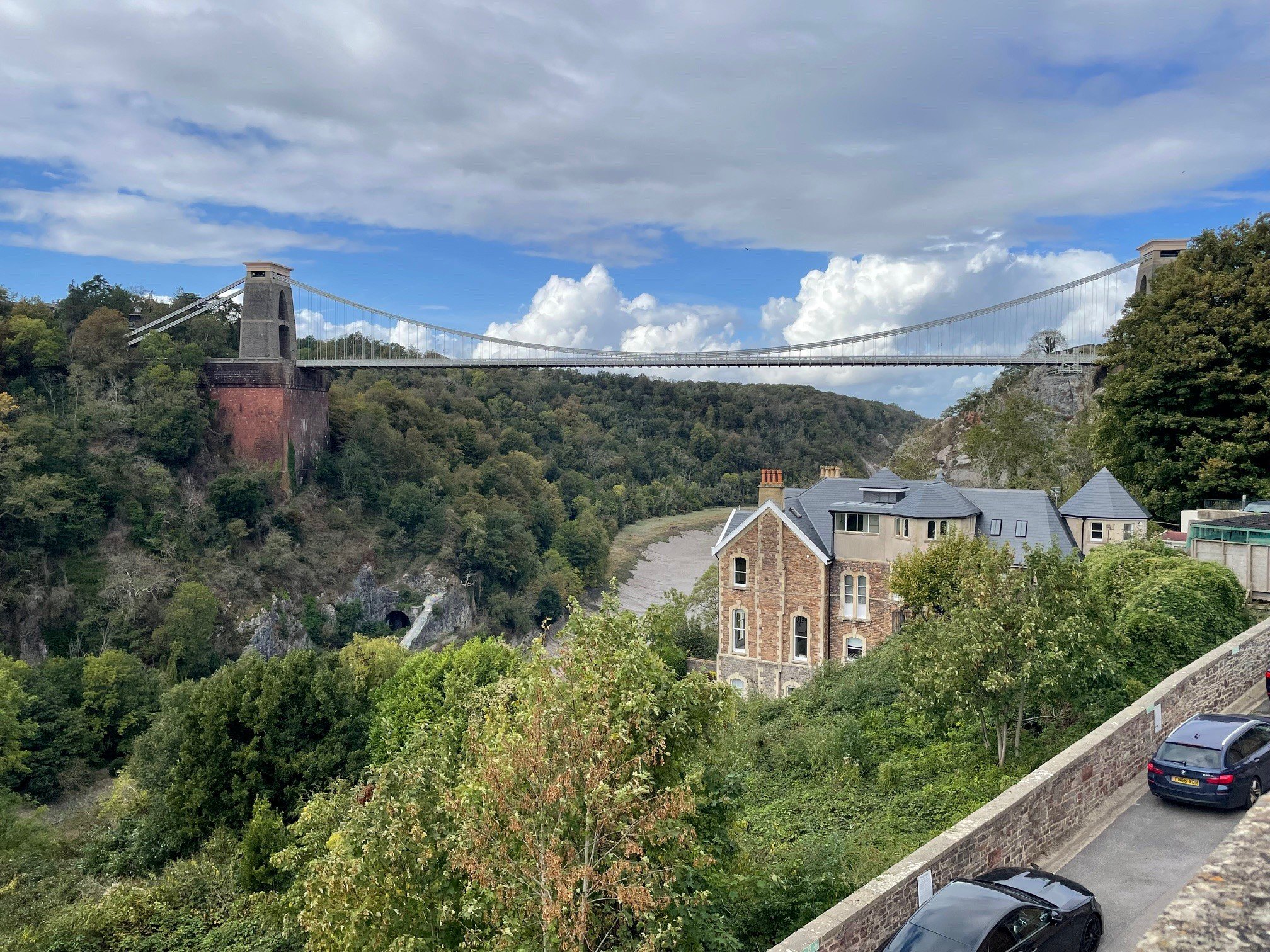
At the end of September 2026 President John Beck led a party of enthusiastic members on a voyage to Bristol to view some engineering masterpieces. Our voyage began with dinner and an overnight stay at the St Pierre Hotel, Chepstow, set in 400 acres of parkland across the Severn Bridge from Bristol itself. The St Pierre estate dates back to Norman times and incorporates a small 11th century private church and 14th century gatehouse.


The Clifton Suspension Bridge

The Avon Gorge at Clifton is not symmetrical; the eastern side at Clifton has a vertical rock face whereas the western side, towards Leigh Woods, has a 45° slope. The 23 year old Brunel’s winning design addressed the asymmetry by building out an abutment on the west side to reduce the overall span and give balance to the bridge. There was no government funding of infrastructure projects in the 19th century with the Clifton Bridge Company having to raise money from shareholders. Funding was finite and in the 12 years after winning the competition, Brunel built the masonry abutments, towers and bridge approaches, but ran out of money for the suspension chains and deck. The abutments and towers remained as an embarrassing half built project for almost two decades. It was the HS2 of its age.

Brunel is a paradox in that his overall design vision was always bold and visionary, whereas his construction was solid and conservative. The Leigh Woods abutment contains vaults like cavernous cathedrals which are stacked two high towards the base of the gorge. There are 12 vaults within the abutment forming a solid plinth for the bridge towers. The vaults are constructed in red sandstone whereas the towers are in grey Pennant sandstone. The vault walls are over 1m thick with an arched roof constructed in dressed blocks set in lime mortar. The tower piers either side of the bridge deck continue down as solid supports within the abutment vaults. Further vaults to the outside support the pedestrian walkways and give lateral stability to the base of the tower. Over the years water has percolated the abutments dissolving the calcium carbonate in the lime mortar and producing spaghetti like stalactites up to 7m long to form from the arched roof.

When Brunel died, it was his fellow engineers, Hawkshaw and Barlow, both ICE Presidents, who took the white elephant forward to a completed project. It was the manic expansion of the London railways in the second half of the 19th century that was the catalyst for the completion of the Clifton suspension bridge. Brunel’s original Hungerford Suspension Bridge across the River Thames was for pedestrians. This was demolished in 1860 to make way for Hawkshaw’s railway bridge between Waterloo and Charing Cross. Hawkshaw salvaged the chains and saddles, recognising that these could be reused at Clifton and in the next 4 years along with Barlow he reinvigorated the funding and completed the bridge. Tension assemblies are only as good as the weakest connection and with the greater span and increase in loads from pedestrians to vehicles, Hawkshaw used three chains at Clifton rather than the double chains on the Hungerford.

Maintenance was not a priority to the Victorian engineers. Brunel sealed the vaulted Leigh Woods abutment without access. With the demise of the original bridge company, records were lost and it was only in the 21st century that a doorway was stitch drilled through the abutment outer wall to gain access to the vaults themselves. This was the first time that the vaults had been seen in 150 years and were in sound condition, as a testament to the care with which Brunel had taken in their construction.

Norman Train
The day continued with lunch at the Hotel du Vin, a presentation from the Clifton Bridgemaster and a visit to the SS Great Britain: see The SS Great Britain – impressions.
Event details: President’s Day to Bristol.