

The second part of our report on the 2026 President’s Day. The first part, St Pierre and the Clifton Suspension Bridge, covers the morning.
Lunch was enjoyed at the Hotel du Vin, Avon Gorge, after which we were privileged to receive a presentation from Tristan Ralph, the Clifton Bridgemaster. We were soon off again however, this time to visit the SS Great Britain at Bristol Dockyards Museum.
The SS Great Britain – impressions
There is much information about the Great Britain available on the internet, so this description is reflecting what we actually saw on our visit.
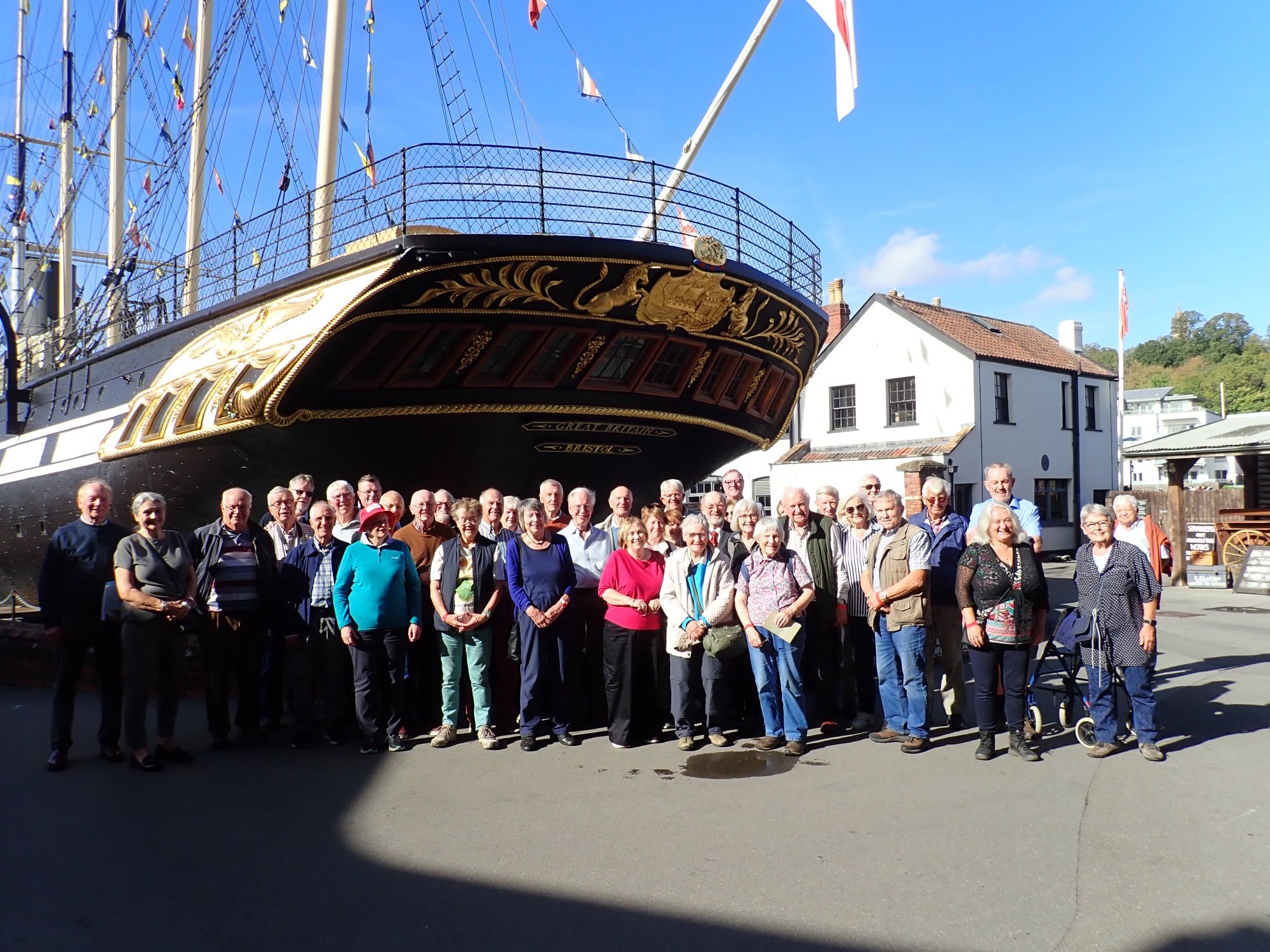
As soon as it comes into view, the ship immediately catches the eye with its beautifully painted stern end, bearing gold painted decoration as well as the ship’s name and home port of Bristol.

The first thing one notices is that it appears to be floating in the dock, as there is a horizontal glass screen filling the gap around the ship at the level that the sea water would have been. This is not there just for effect, as below the screen is a closed space in which two very large de-humidifiers maintain the space beneath at 20% relative humidity to minimise deterioration of the wrought-iron hull. An air-lock allows visitors to first walk around the base of the dry dock and see the outside of the hull and the large red-painted propeller and rudder.

Climbing up a staircase and through the airlock then allows one to access the open main deck (completely replaced a few years ago) which certainly gives a good impression of size. One of the first things in view is a cow in a stall – on the voyages to Australia it was normal to take livestock (a cow, 36 sheep, 140 pigs, 96 goats and 1,114 chickens, ducks, geese and turkeys) for use in the ship’s catering!

Towards the rear of the vessel stands in open air the steersman’s wheel (helm), along with a binnacle containing the compass.
Below the top deck are two decks for accommodation of the crew and passengers, all of which have been most effectively installed in what arrived from the Falklands as a bare shell of a ship. Areas are set aside for the dining rooms, promenade spaces, galley, services such as the doctor and hairdresser, etc. All of the large spaces appear quite airy, with overhead windows letting in daylight, but not the weather. In particular, the large and spacious First-Class Dining Room was a very elegant affair, with crockery, silver cutlery, and napkins to match.

A number of cabins may be seen, and a number have been given mannequins to show how passengers would have lived – parents, babies and children in ‘family cabins’, ill patients in a ‘sickbay’ cabin, and so on. One thing that was immediately apparent was how narrow the berths were – even in first class.
Those in lower-class accommodation had somewhat smaller spaces, and in fact the 4th-class passengers had to endure open bunks, three high in the sides of an open area! Similarly, lower-class eating was at long ‘shelves’ along the side of the area, with limited spaces – some having to wait until others had finished eating. Some of those in the lower-class cabins were able to provide services such as barbering, or doing work as seamstresses, for the First-Class passengers.
In midships, the boiler and engine areas could be seen – the boiler produced steam at 10 psi was supplied to the main steam engine arranged rather like an upside-down V-four, driving a crankshaft attached to a large pulley of about 16ft diameter, turning at about 18rpm, connected by a wide belt to a smaller pulley on the main propeller shaft which gave around 54 rpm for the actual propulsion. The replica cylinders were based on the originals, and had an 82-inch diameter and a stroke of 72 inches!

For both the engineers, and their partners, this was a most interesting visit!
Chris Lumb
Event details: President’s Day to Bristol.