

Lecture by Terry Spall BSc, MSc, CEng, FIMechE, FREng

Few technologies are changing as rapidly as the motor car. In a lively and thought-provoking lecture, Terry Spall, Past President of the Institution of Mechanical Engineers, looked beyond today’s electric-vehicle debate to ask what personal transport might actually look like in 2030 — and 2050.
The speed of the electric revolution is striking. In 2011, British buyers had a choice of just two fully electric models. Today there are hundreds. Range has risen dramatically, battery performance has improved and costs have tumbled: battery prices, once above $1,000 per kWh, have fallen to around a tenth of that. Electric cars are moving rapidly from novelty to mainstream.

But Spall’s central message was more complicated than simply “electric is good”. An EV may produce no exhaust emissions, but manufacturing its battery requires substantial quantities of lithium, nickel, cobalt, graphite and other critical minerals. Extracting and processing these can carry a considerable environmental price. Rare-earth production can generate contaminated water, toxic waste and radioactive residues, while cobalt mining in the Democratic Republic of Congo raises serious ethical concerns.
Much of the processing is undertaken in China, which has built a commanding position in the supply chain for batteries and critical minerals. The uncomfortable question is therefore whether the developed world is partly exporting the environmental consequences of its green transition elsewhere.

There is also a question of sheer availability. Electrifying a global fleet heading towards two billion vehicles will require extraordinary quantities of minerals. Known reserves may prove inadequate, while developing a newly discovered mineral resource into a producing mine can take many years. The ocean floor contains enormous quantities of valuable minerals, but exploiting them could create another environmental dilemma.
Technology may, however, provide part of the answer. Sodium-ion batteries are particularly promising. Sodium is extraordinarily abundant and potentially cheaper than lithium, while sodium batteries can operate well at low temperatures and present a lower fire risk. Solid-state batteries promise another leap forward, potentially providing much greater energy density and ranges approaching 500 miles.
Hydrogen, by contrast, looks unlikely to become a mainstream fuel for cars: producing, compressing and distributing it is inefficient and the refuelling infrastructure remains tiny.
Perhaps the most intriguing change, though, concerns not what powers cars but who — or what — drives them. Autonomous taxis are already operating commercially in parts of the United States, while increasingly sophisticated systems are appearing on conventional cars. Spall envisages robotaxis becoming commonplace, potentially challenging the assumption that everyone needs to own a car. That could have a profound social benefit. Fully autonomous vehicles might eventually preserve personal mobility for people who can no longer drive through age or disability.

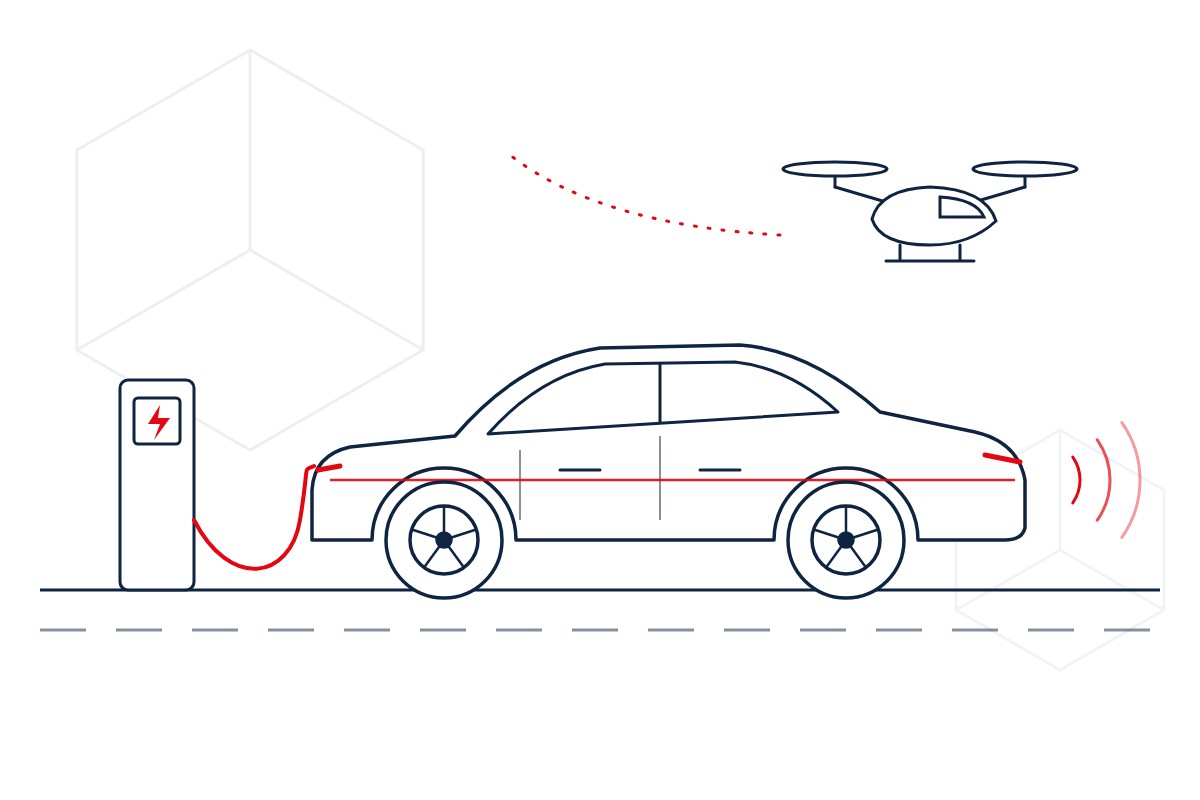
And after autonomous cars? Look upwards. Hundreds of companies are developing electric vertical-take-off-and-landing aircraft — effectively airborne taxis. Some are already flying.

Spall’s conclusion was that by 2050 the “car” may bear surprisingly little resemblance to today’s machine: predominantly electric, increasingly autonomous, perhaps shared rather than owned — and, occasionally, not on the road at all.
Matthew Symes
Event details: Driving Ahead – The Future of the Car.