

A lecture by Alan Denney
This lecture was drawn from Alan Denney’s work at Arup in the early 1970s where he was employed as the first metallurgist working in their R&D department. The dominant thread was his work on innovations in steel structures, but the talk started with Alan talking about the ‘doctor’s surgery’ provided by the Arup R&D department and the extensive variety of metallurgical issues which emerged from the ‘consultations’. The talk then focussed on the interlinked themes of the use of castings in structural engineering, fire engineering of steel structures, and the introduction of steel castings for offshore structures, together with the Centre Pompidou (1971–1977) and Bush Lane House (1973–1976) as notable projects for presentation.
Alan weaved the importance of welding as a topic throughout the lecture, how he found it to be a critical element in his work which resulted in him taking leave of absence from Arup to go and do an MSc in Welding Engineering at Cranfield University.
Centre Pompidou
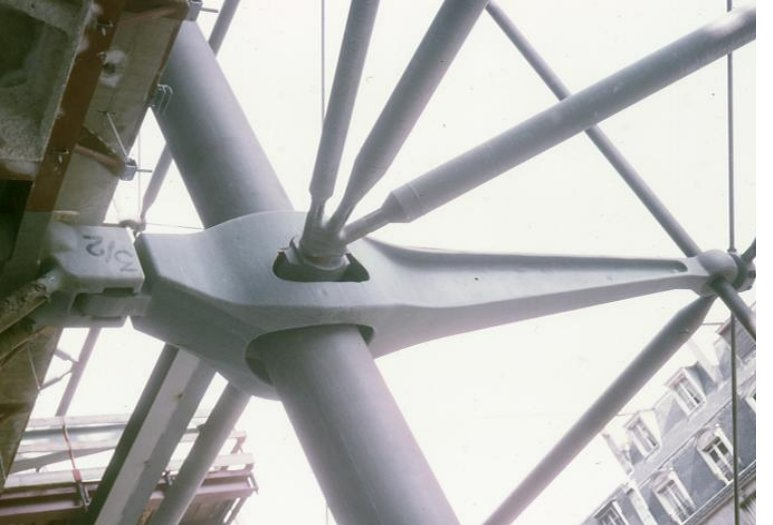
The Centre Pompidou in Paris (currently closed for renovation until 2030) was a remarkable concept in 1971. The design concept was to achieve exceptionally wide span, flexible clear exhibition spaces, with all services and access on the building’s facades. Peter Rice, the structural engineer, wanted the steel structure to show ‘the cast steel aesthetic’, which presented challenges of material, manufacturing and fire protection. Alan outlined the role of Larry Seigel of US Steel in ‘tutoring’ him on the use of internal water filling as a means of fire protection (actually a solution of potassium carbonate with potassium nitrite as corrosion inhibitor) and he touched on the programme of work performed at the Atomic Energy Research Establishment at Harwell to demonstrate its viability. The progressive development of the project was well illustrated with a collection of progress photographs.
Bush Lane House
Bush Lane House, a much smaller but highly innovative building in the City of London, was designed by Arup Associates as architects and engineers, and presented structural, materials, fire protection and fabrication challenges. Arup’s R&D department drew on what had been learnt in the development of the Centre Pompidou, with the added dimension that the exposed structural steel frame had to be a high strength stainless steel. The solution was found to be to use duplex stainless-steel castings for the exposed steel structure, which the architect within Arup Associates, Richard Raines, used to advantage to create an exceptional clean aesthetic. The tubes were manufactured by centrifugal casting and the ‘nodes’ by sand castings. Castings and the lattice fabrication were by companies in the APV Group in the UK.
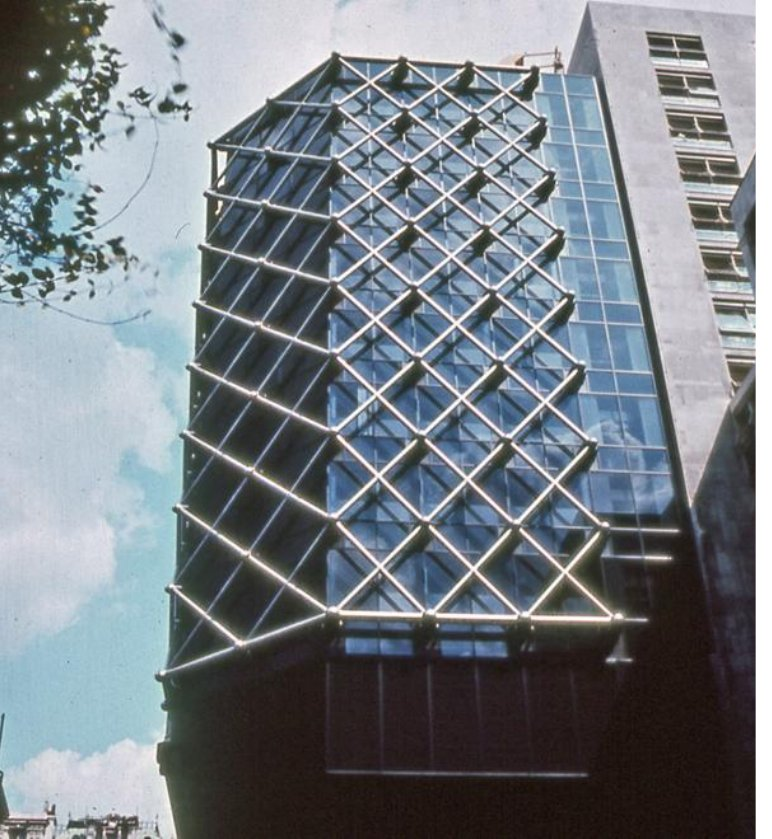
Alan expanded on the constraints on the site which necessitated a lattice structure. He explained the extensive programme of studies into candidate materials and their properties and fire protection, which included qualification testing of materials and welds, and exposure and strength tests on full-size trial structures. He presented a fascinating series of images of component manufacturing, the clever fabrication methods used to produce lattice frames within tight tolerances and their careful finishing and protection to give an impeccable exposed stainless steel lattice structure when assembled.
Alan talked about the means of overcoming the low slip factor which was found with stainless steel surfaces in contact, which was a serious design constraint on the bolted interfaces for the structure.
Fire engineering and offshore castings
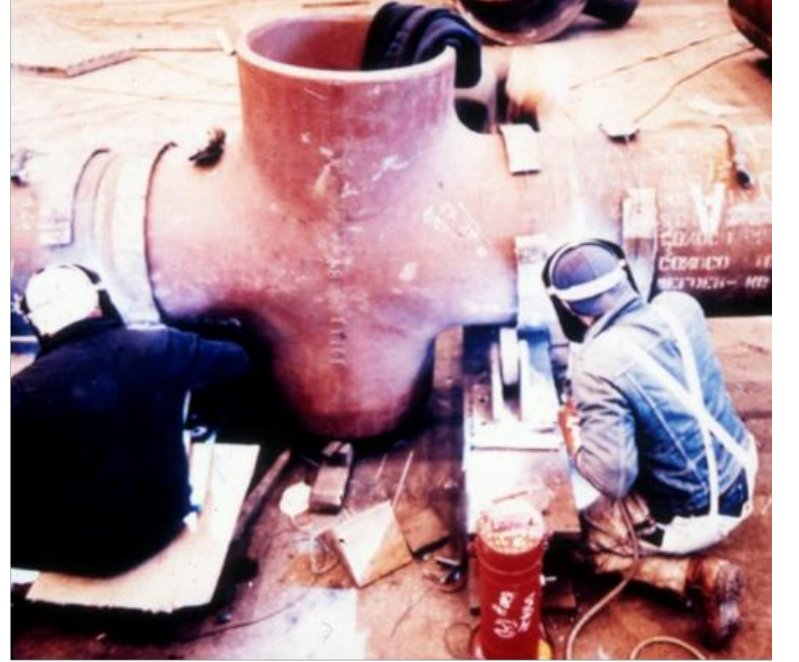
Alan then outlined how fire engineering developed within Arup as a specialist area in the period following the Summerland fire in 1973. He finished by outlining how the offshore industry picked up on the use of steel castings, with work at the River Don works of British Steel (now Sheffield Forgemasters) and their adoption for the Conoco Victor platform in 1982 and the subsequent development including the 96 tonne launch leg nodes for the Ekofisk 2/4J platform.
Andrew Graham & Alan Denney