

Spring Voyage to the North West of England, 13–17 May 2026. This is the third of three reports.
Saturday 16th May: the Hill Dickinson Stadium and Liverpool Anglican Cathedral
Following our very full day visiting sites in the wider region, our Saturday itinerary was concentrated on features in the city of Liverpool itself. Travelling north along the dockside road we viewed the Hill Dickinson stadium, the new home ground of Everton Football Club, built on the site of the former Bramley-Moore Dock. With a capacity of over 52,000, the stadium is a bowl design constructed of steel and glass, and is the eighth largest football stadium in England. The name “Hill Dickinson Stadium” results from a naming rights partnership with the long-established law firm Hill Dickinson, whose headquarters is in Liverpool. The building of the new stadium was not without controversy: the Bramley-Moore Dock was within the Liverpool Maritime Mercantile City, which was a UNESCO World Heritage Site. The Bramley-Moore development, together with the general development of the waterfront, contributed to UNESCO’s recommendation that the city lose its World Heritage status.
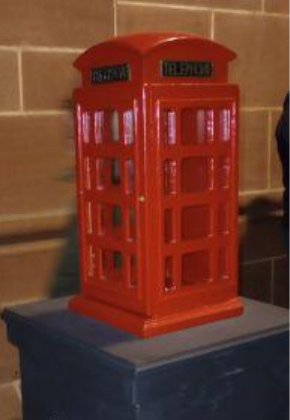
Liverpool Anglican Cathedral, constructed of local sandstone between 1904 and 1978, is a fine example of Gothic Revival. It is the work of the architect Sir Giles Gilbert Scott, who also designed many other notable buildings, as well as the ubiquitous red telephone box.
It is the largest cathedral in Britain and the fifth largest cathedral in the world. With a total external length of 189 metres (621 feet) including the Lady Chapel, it is also the longest cathedral in the world. The superlatives do not stop there: the bells are the highest and heaviest ringing peal in the world, and the organ is the largest pipe organ in the UK.
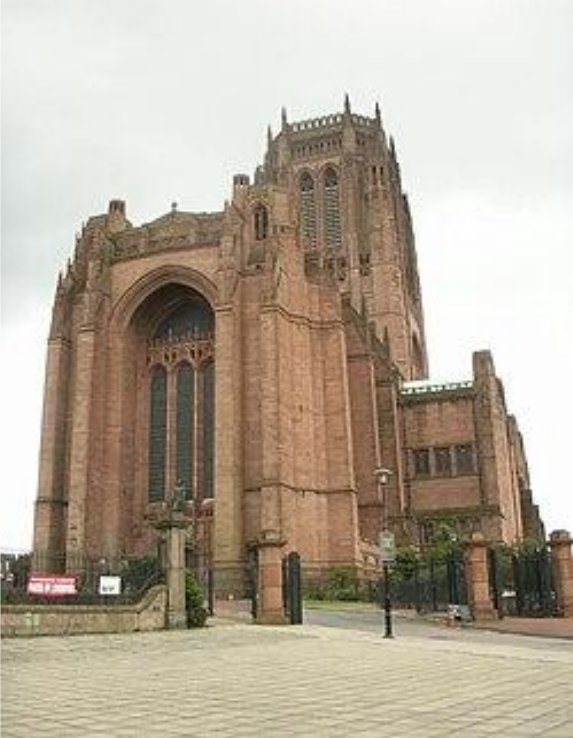
Our tour of the cathedral demonstrated the sheer enormity of the edifice, and enabled us to view some of the commemorative and memorial features, including the War Memorial Chapel, housing the Roll of Honour for over 40,000 men from the Liverpool area who died in World War I, and memorials to the King’s Regiment (Liverpool), the RAF, the Battle of the Atlantic and the Burma Star. Other memorials include those to David Sheppard, Test cricketer and former Bishop of Liverpool, as well as the Titanic, which was registered in Liverpool. The cathedral’s architect, Sir Giles Gilbert Scott, is commemorated with a tiled memorial in the floor in the centre of the cathedral.
Our tour was followed by a sandwich lunch within the cathedral, which afforded a welcome rest before our afternoon programme.
Edmund Morgan-Warren
The Three Graces and the Mersey Tunnel
Saturday afternoon’s events involved a tour of the waterfront in front of the Three Graces, the iconic buildings at Liverpool’s dockside. It involved significant fitness challenges for the members as we had to attempt hundreds of steps to reach deep under the road tunnels and to the top of the Liver Building itself.
The tunnel guides, Bill and Alison, explained that the Three Graces were built over Victorian docks, on a series of tunnels and piers reaching down to the bedrock, and water still flows under all the buildings as the tide rises and falls. The original tunnel was a railway tunnel built in 1886 and then two road tunnels followed later. Queensway Tunnel was opened in 1934 and was dug entirely by hand. It has a diameter of 40 feet, allowing four full lanes of traffic to flow through the tunnel. Two tramway tracks running underneath the roadway were later abandoned. We were lucky enough to visit alongside the live roadway directly underneath the river.
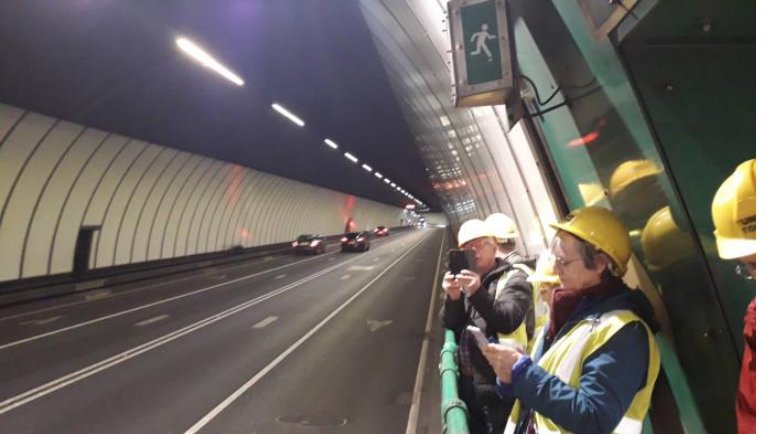
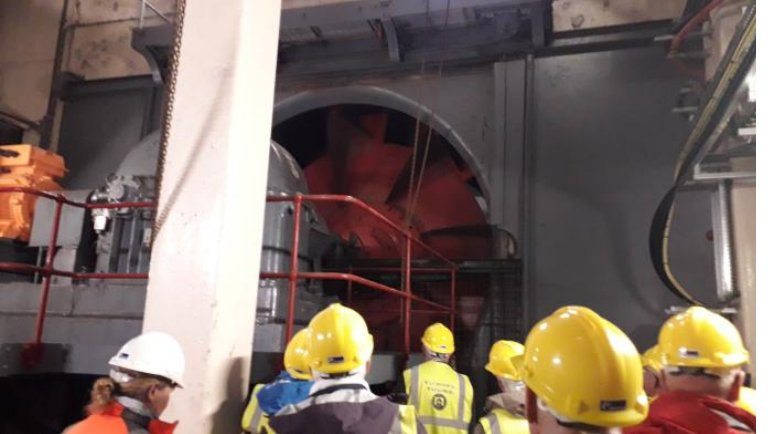
Safety in the tunnel was enhanced following a disastrous fire in a tunnel in Zurich, and we were shown the safety escape rooms located beneath the roadway. The tunnel is actively ventilated with 28-foot diameter fresh air and exhaust fans moving air from each side under the roadway. The fans and control room are housed in the “fourth Grace”, an ornate building designed in the Egyptian style of white granite, black statues and green paintwork.
Additional tunnels were built in the 1970s to cope with extra traffic as a twin-bore design, both of 28 feet diameter, and entirely machine-bored.
The Liver Building is the most iconic of the Three Graces at 336 feet high, with the 17 ft tall Liver Birds, Bertie and Bella, mounted on top. Bella looks out over the river, allegedly waiting for her sailor to return home, whilst Bertie overlooks the city of Liverpool – looking for a good public house!
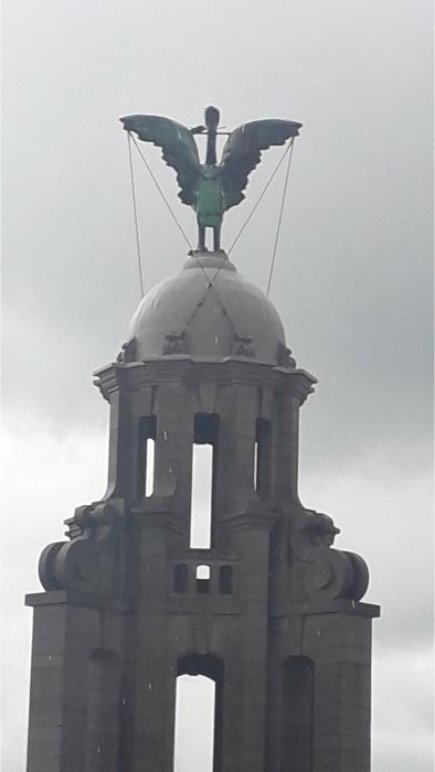
It was designed and built in just 3 years by the architect Walter Thomas, completing in 1911. It was built using the (then) novel Hennebique technique of steel reinforced concrete beams with white granite cladding. The method was copied from a similar building in Cincinnati. We were taken to the 10th floor by lift, then 130 steps to the viewing platform at the top. The scene of Liverpool was best described as “atmospheric” as the heavy drizzle obscured much of the view.
We returned to the hotel via a tour of the waterfront in heavy rain, the most notable aspect being the sad memorials to the seamen lost during wars and accidents at sea.
Mike Dyson
Editor’s note: on the final evening, several members of the party could not miss the opportunity to visit the “Cavern Club” in Mathew Street, although sadly not the original one made famous by the Beatles.