

A lecture by Roger ter Haar KC
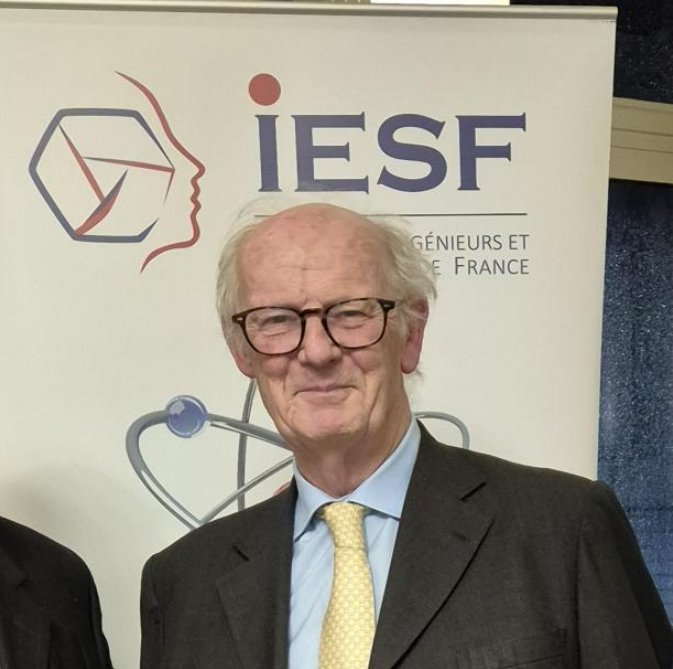
Roger ter Haar started his lecture by stating that his dealings with our Hon Sec Chris Foster made him realise that engineers and scientists do view the world differently from lawyers, and that included what was the truth. That is not to say that one is wrong or one is telling a lie, it is just that they generally view it from a different angle. Engineers and scientists endeavour to express what they believe to be the basic facts; the truth. Unfortunately, in the past, this has sometimes been wrong. Before Copernicus theorised to the contrary, the perceived truth was that the Sun circled the Earth. That was a stated fact, that was the truth. We all now know that is not correct; it is not the truth.
From a lawyer’s viewpoint, it is not necessary for all the information to be correct, rather that the facts matter. He gave the example of himself and a friend watching a car running a red light at a crossroad and crashing into an innocent motorist who was driving across the junction. In their witness statements, he saw a blue Ford drive through the red light, his friend saw a red Volvo. They both couldn’t be right. What was the truth? From a lawyer’s perspective, it didn’t matter what colour or make the offending car was, what mattered was that it illegally drove through a red light and caused the crash.
Time lines
An important part of the difference between the lawyer’s answer as to what is the truth is that the lawyer requires the answer within a defined time frame, whilst the scientist, generally, has all the time in the world. In a court case, a decision is final (subject to the rights of appeal etc). Similarly, an engineer’s decision on the design of a structure for example is very final (that is what is built). However, a scientist can revisit earlier beliefs as to the truth as more information becomes available which corrects or enhances previous knowledge.
Testing and proving hypotheses
In science, discovery of the truth may start with a known phenomenon but of which the causes are unknown. A hypothesis as to its cause may be developed which is then tested by experiment or further observations. A prime example was the observation of a cholera outbreak in the area around a local water pump which pinpointed the source of the disease.
Similarly, in a criminal case, the police know a crime has been committed. As the evidence is gathered, hypotheses may form in the investigators’ minds. Eventually a single hypothesis hopefully emerges to be able to convince the court that the case is proven beyond a reasonable doubt. But often the hypothesis is flawed because the evidence is not complete which is often due to the Law’s desire for finality. Also, in court, the defence’s position is not to seek the absolute truth – who committed the crime – but to show that their client didn’t. In civil cases, both sides will present favourable evidence and ignore that which is not favourable to their client. Although not telling lies, they are only presenting limited truth.
When faced with a problem, the scientist starts with a hypothesis and then tests the options until it is proven or otherwise. However, a scientist will aim to present all the evidence – the truth – even if this could be counter to their hypothesis. Whilst this might suggest that they are more honest than lawyers, the reason is that eventually any undisclosed evidence will emerge as there is no time limit on scientific research, unlike the legal system’s desire for closure.
Roger concluded his lecture by stating that lawyers desire an answer, the truth, within a defined time frame – “justice delayed is justice denied” – and once a decision is made that is final.
In science and engineering, the process is to produce an answer, the truth, that works until a better solution is formulated.
Both sides aim for the truth, although viewed from a different perspective!
Paul Gerrard