

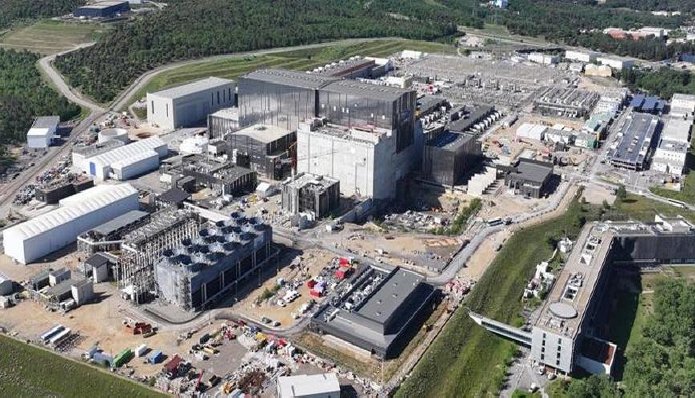
Friday 12 September: visit to the International Thermonuclear Experimental Reactor (ITER)
After a long coach ride and following stringent passport and security checks to gain entry onto the nuclear site, classified as international territory, the group was welcomed to ITER by Yutaka Kamada, Deputy Director-General. After his welcome address, an official group photo marked the event, organised by the chief communications officer, Kirsten Haupt.

Three senior ITER staff presented conference papers. Michael Walsh, Head of Fusion Technology & I&C Division, described the Physics of ITER, “how it works and why it matters”. Margaret Graham, Fusion Technologies Section Leader, described how ITER is built with more than a million components required to form the giant 23,000 tonne Tokamak, heavier than 3 Eiffel Towers. Laurent Patisson, Project Leader of Civil Engineering & Interfaces, described the complex design and construction of the principal nuclear buildings and their challenging compliance with technical and nuclear codes to ensure totally safe shielding and confinement.
In appreciation, each ITER representative was presented with a gift and a copy of the IESF British Section centenary book. For further background information on ITER, see https://www.iter.org/few-lines

With a site in south-east France selected for construction, the ITER project protocol signed in 2005 involved 7 partners: China, European Union, India, Japan, South Korea, Russia and USA. Now with 27 EU member states, the workforce currently comprises more than 33 nationalities providing components. Although the working language is English (albeit the UK will be leaving the project this year at the end of its current contract), many different languages were heard when walking through the restaurant to a buffet lunch.
Afterwards, the group donned full PPE for the site tour to the Tokamak Complex and split into two groups to enter the clean room Assembly Hall and the viewing pods around the Tokamak Reactor Pit.

In the former, the massive components are put together before being lifted by 750 tonne capacity gantry cranes and carried over a separation wall into the Tokamak Pit where they are lowered into place with millimetre precision. The nine vacuum vessel sectors each weigh 1350 tonnes, requiring tandem lifts by the two principal gantry cranes working together.

Having visited the Tokamak Complex with its tritium and diagnostic buildings, the site tour passed the control building, chilling and cooler farm, secondary assembly hangars and store areas, cryostat and cryogenics buildings, power supply and heating plants before returning to the administration building to return PPE and security passes. To learn more about fusion energy go to ITER’s website.
William Powles
Visit to Château Val-Joanis, Pertuis
After a half hour’s drive, we arrived at Château Val-Joanis to be welcomed by owners Manuella and Noel. Manuella gave us a brief history and description of the château buildings, garden and Caveau. The estate covers 400 hectares with 110 hectares of vines and has been in the family for 15 years. The garden was laid out in 1978 as a historic garden and it was awarded the Jardin de l’année in the ‘Jardin Remarquable’ category in France in 2008.
We then visited the Caveau which contains ten double-walled vats of some 25,000 litres capacity. The double walls allow the fermenting wine to be chilled by water to various temperatures to suit the various types and qualities of the wines. Manuella gave us a very interesting insight into the wine making process including an account of how white wine is produced from black grapes. On account of its age, the wine transfer system is quite labour intensive. Ideally, the equipment would be completely re-modernised with an underground pipework system. However, this is impractical as it would require every barrel to be completely drained at the same time.

Manuella also explained their appellation which applies to very local terroir (see note below) which dictates the appellation requirements very precisely. Climate change is now a big worry because with less rain the vines start to turn yellow and the yield drops. When asked about going organic, Manuella said that the whole area would need to change. In any event they use a minimal amount of chemicals, say for example after a lot of rain when treatment is required to prevent rot.
We were then given time for a quick look around the garden and to admire the plants and the fruit and vegetables which are appreciated by the fifteen people who are employed on the estate.
We then gathered in a large hall where Manuella introduced three wines, white, rosé and red which were sampled after an extensive explanation of their bouquets and technique for savouring them.
Before dinner we sat under the impressive platane (plane) trees and enjoyed a wonderful jazz concert, energetically delivered by local quartet, Group Basilic Swing, comprising a violin, two guitars and a clarinet. The performance included a wide selection of popular melodies. This was followed by an interesting, al fresco dinner washed down with copious quantities of the château’s red and white wines.

After dinner a presentation was made to Margaret and Kirsten from ITER who were there as our guests as a thank you for arranging the day’s visit to the nuclear site.
Note: in wine, terroir is the “sense of place” that results from a unique combination of environmental factors, including soil type, climate, topography, and local flora and fauna, which influence the grapes’ growth and the final wine’s distinct character. These natural elements combine to create a wine with a specific identity that cannot be replicated, even with the same grape variety and winemaking technique.
Editor’s note: L’abus d’alcool est dangereux pour la santé, à consommer avec modération!
John Baron