

A lecture by Chris Binnie FICE FCIWEM
With annual global temperature about to exceed the agreed target of +1.5 deg C above pre-industrial levels, UK Government policy is to eliminate fossil fuels where possible, doubling electricity generation to provide energy to replace domestic gas heating and cooking; for heat pumps, air conditioning, electric car charging; and to service power-hungry data centres and industrial demand such as electric arc furnaces.
Future demand might be met by some combination of nuclear, solar power; tidal stream energy and tidal lagoons; onshore or fixed or floating offshore wind generation and imported energy. Current methods have significant drawbacks. UK nuclear power projects suffer from delay and cost overrun, and shortage of suitable safe long-term storage of spent nuclear fuel. Although the UK has 17GW power output from solar panels, these are mostly Chinese made, with expected lifespan of 25 years; power output is weak at peak demand, and land use is substantial. Wind-generated energy (like solar energy) is intermittent; turbines have a life of 20-25 years, with a third of those currently installed needing to be decommissioned by 2035 and their infrastructure removed, including foundations. By 2030 total UK wind power generation is forecast to increase from 15 to 27 GW onshore and from 15 to 43 GW offshore; new north-south links are proposed to transmit power generated from east coast Scotland south to east coast England, with high transmission costs for new subsea cables. In times of high demand energy is imported from mainland Europe by subsea cables and pipelines, a potentially expensive source, open to the risk of sabotage.
From the cost comparison below, tidal range is a significant source of alternative energy. The House of Commons Environmental Audit Committee reported in 2023 that tidal energy should be a vital component for net zero and energy security.
| Energy source | Energy cost £/MWh | Life in years | Link to grid |
|---|---|---|---|
| Solar | 50 | 25 | No |
| Onshore wind | 59 | 30 | No |
| Offshore wind, fixed | 81 | 30 | No |
| Tidal range, West Somerset Lagoon | 64-85 | 120 | Yes |
| Hinkley C nuclear | 130 | 60 | Yes |
| Sizewell C nuclear | 110 | 60 | |
| Floating offshore wind | 140 | 30? | |
| Tidal stream | 172 | 30? | |
| Wave | 250? | 20? |
Tidal stream energy generates electricity from turbines in tidal currents. About 25m water depth is needed for efficient operation and a velocity of 2m/sec. Within the UK the Bristol Channel has the highest tidal range, but only its deepwater shipping channels have the requisite water velocity for tidal stream energy.
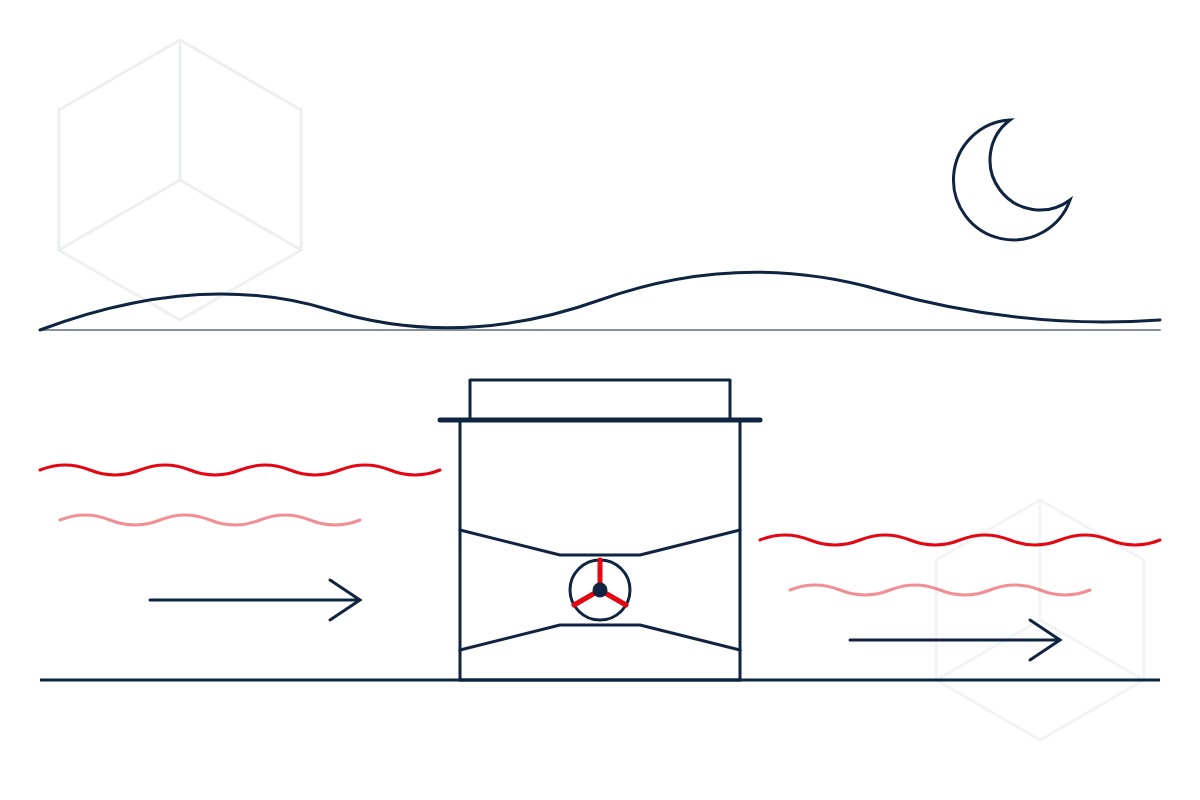
Tidal range energy from a lagoon system provides a potential solution, operating across the barrage between the sea and the lagoon by means of 6-8m diameter bulb turbines.

There are two options: ebb generation with two passes per 24 hours or, more commonly, two-way (flood and ebb) generation with four passes per 24 hours with less intermission time (approximately 2 hours), more suited to the electricity grid and local natural environment.


The system is flexible, used when needed and has proven technology, for example the Rance Barrage.

Overall benefits of tidal range power include predictability, reliability, proven technology with low risk of sabotage and no dangerous long-life waste. Around the UK, the Bristol Channel, Irish Sea and North Wales have a tidal range of 9m. Projects examining tidal power have included the Severn Barrage with ebb-only operation. However, interference with shipping access to Avonmouth Docks, and high lock cost; with migrating salmon and shad; and loss of 140km² of intertidal habitat were significant drawbacks. By contrast, the West Somerset Lagoon (WSL) project is sited on the coast between Minehead and Watchet outside the areas of ecological and environmental sensitivity. It is proposed to be a semicircular 80km² area bounded by a wall of concrete caissons, with a tidal range of about 10m. In total, 125 turbines will be set around the perimeter in five groups, and sluice gates in eight groups, with generating capacity of 2500MW, or 6.5TWh/yr at a predicted cost of £11 billion.

Sited in an area of significant coastal erosion, the scheme will help protect the South West Coast Path and West Somerset Railway, and reduce the risk of severe coastal flooding predicted for 2100. The lagoon wall reduces storm surges, and controls the water level in the lagoon. Though detailed environmental impacts are awaited, proposed mitigations will protect local and migrating fish and eel populations and migrating birds. Calmer conditions within the lagoon offer potential benefits for recreation. Construction would entail upgrade of the A39 road.
However, with the projected development programme for WSL stretching over two parliaments, from 2025-2037, funding is an issue. The Swansea Bay Lagoon Scheme was turned down for failure to qualify in the payback period of the Treasury. It would be a pity if WSL suffered the same fate.
Peter Blair-Fish