

10th to 14th September 2025
The start of the journey for the 32 voyagers travelling from St Pancras Station was threatened by a London Underground strike together with an unofficial strike in France. Would we get to the South of France on Day One? We need not have worried, as our organisers had coordinated the journey to Avignon flawlessly, well in time to settle into the hotel before our evening meal.
Thursday 11 September: from Roman Arc de Triomphe and Théâtre Antique to a dramatic new building by Frank Gehry
Our visit started at the Arc de Triomphe in Orange, our first UNESCO site of the day. Our guide informed us that this arch is the oldest surviving example of a design that was used later in Rome.

The arch was part of the town’s protection system guarding entry to the town. Made of large limestone blocks, it has three arches, the central one being larger than the two outer ones.
Our guide was very keen to point out the significance of the messaging in the well-preserved carvings from military scenes to a wolf to bees, to hexagons that could be honeycombs, roses (in bud, bloom and faded), and a specific carving that had been interpreted to say “you are welcome here but obey our rules or else!!”
Naturally we obeyed and dutifully followed our guide to the most impressive Roman Theatre still existing in Europe which is located beside a monumental temple complex and a forum with original Roman walls. In 1869, the Roman theatre was restored and is now famous as an international opera festival. We were guided around the site, up the steps of the arena and through the system of gallery tunnels. It was explained that in the past, people were allocated different areas in the theatre depending on their status with the most important person being at the very front so that everyone knew how important they were.

After a lovely light lunch back at the hotel, it was off again to Arles, about 40 km south west of Avignon and we had time for a walk before our next guided tour at Luma.
William Powles guided us to the UNESCO Roman amphitheatre which is the showpiece of Arles, surrounded by lively restaurants and tourist shops. Apparently, the arena is used regularly for horse and bull racing events in summer. On passing, we viewed the nearby Roman theatre (Théâtre Antique) through the fence. These impressive Roman monuments date back to the 1st century B.C.

Arles is not only a good example of the adaptation of an ancient city to medieval European civilization but now, as we were about to see, also contains an ultra-modern, impactful, creative building set in the Parc des Ateliers, a former railway wasteland covering an area of 27 acres on the south east of Arles.
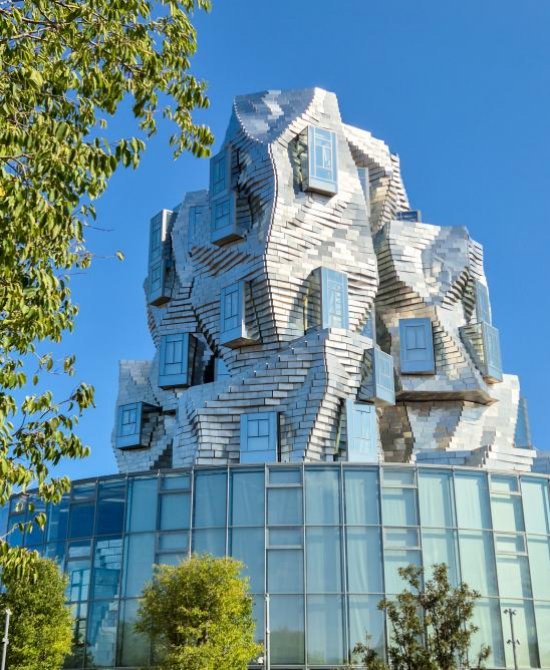
Now, seven old factories from the 19th-century industrial heritage are being transformed around the new Frank Gehry Tower, the Luma, which has a twisted façade decorated with 11,000 large stainless steel bricks and 53 glass boxes.
Inaugurated in June 2021, this striking new building now houses various multi-purpose spaces, from exhibition halls to work and research rooms, and event venues. We were fortunate to have Peter Terrell, structural engineer to the project and IESF member, with us to give some additional insights into the role he played in bringing the vision into reality.

Luma: key facts and figures
- Height: 56 metres
- Floors: 12 (10 storeys)
- Façade: 11,000 stainless steel bricks, 53 glass boxes
- Rotunda (the Drum): diameter 54 metres; height 16 to 18 metres; 670 tons of glass
- Surface area of the interior spaces: 15,000 square metres (of which 2,000 square metres is usable for exhibitions); 1,400 square metres dedicated to the archive programme
We entered via the Drum, a glass rotunda inspired by the Arles Amphitheatre, and had our introduction to the building seated against some of the great variety of stainless steel boxes. I was distracted by a large motorised piston which was later confirmed as the device which opened the window.
We were guided through each floor to the top floor where we were rewarded with amazing views of Arles and the local countryside. The tour took us on a journey past art works: ‘Take Your Time’ by Olafur Eliasson, which was a large circular mirror which slowly rotates, a wall beside the lifts covered with tiles of salt, to the Isometric slides by Carsten Höller which had to be tested by most IESF members before we could leave!

A different “down to earth experience” to remember!
Isobel Pollock-Hulf