

Saturday 13 September: visit to the Pont du Gard
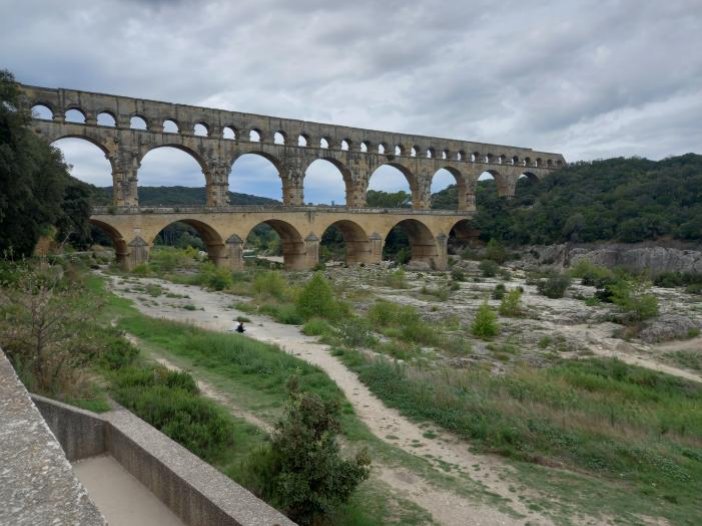
The Pont du Gard is a three tier, arch bridge structure that carried an aqueduct from the springs near Uzès to the city of Nîmes on the coastal plain. The bridge is over the River Gardon and is just under 50m high and the top tier was originally over 350m long. Apart from losing twelve of the top tier arches to one of the abutments, the structure has remained intact for 2000 years and is now a UNESCO World Heritage site.

The Romans used water to project both their power and civic pride. Water was used in cities with public water for fountains and baths as well as potable water for homes. Between AD 40 and 60 Roman engineers constructed a 50km aqueduct rising in the natural springs in the hills near Uzès to provide water to the city of Nîmes. The aqueduct channel internal dimensions were typically 2m deep by 1m and it had a stone lid. The lid was to keep flora and fauna out of the potable water supply, to reduce evaporation and to stop farmers on the line of the aqueduct from stealing the water for irrigation.
The difference in elevation between the springs and the coastal plain is 17m giving an average gradient of 1 in 3000. This however is not the whole story in that the aqueduct had to cross the Gardon River and if a constant gradient had been adopted, it would have required a fourth tier to the bridge at a height of 55m which was infeasibly high for engineers in the middle of the first century AD. (In comparison, the Colosseum in Rome is a similar height but was built some 20 years later.) The aqueduct engineers’ solution was to have steeper gradients to the upper reaches of the aqueduct above the bridge and shallower gradients below the bridge at an eye boggling near flatness of 1 in 20,000 (1mm in 20m).
The aqueduct operated for some 500 years, but the limescale deposits from the hard limestone springs caused a reduction in the width of the channel to the point where the water flows were insufficient to supply Nîmes. Originally, the deposits were removed on a regular basis, but this ceased after the fall of the Roman Empire.

The bottom tier is six arches over the River Gardon with a crown height of 19m and a 1m thick ring over. The middle tier of eleven arches has the same profile as the lower arches but has a thicker ring to support the closer spaced piers to the smaller top tier arches. The top tier originally had forty-seven arches 5m high, but twelve of these were cannibalised for their stone when the aqueduct fell into disuse after the 5th century AD. The aesthetic is purely functional; the corbel blocks used to support the formwork and cranes pepper both elevations, but do not detract from the overall majesty of the structure.
The bridge was designed to carry water, not people. The lower two tiers were 6.5m and 4.5m wide respectively giving a 1m wide footpath each side, but this only allowed for pedestrians. In the Middle Ages, the bridge was used for traffic crossing and consequently, the 2nd tier piers were trimmed back on one side to give a better width. Finally in the 18th century a second bridge was constructed to the side of the bottom tier to give vehicular access at which stage the cut outs in the 2nd tier piers were reinstated.
The bridge is constructed of plain stone blocks, cut to shape and placed tight without mortar. It is the durability of the stone and the quality of the original workmanship that has given the enduring structure visible today.
The Roman engineers clearly had access to computer modelling techniques and forecasts of climate change two millennia into the future in that current floods have reached close to the crown of the lower tier arches but never overtopped them.
Norman Train
Pont St Bénézet, Palais des Papes, land train and the evening cruise
Saturday 13th and Sunday 14th September
Pont d’Avignon
Pont St Bénézet is part of the UNESCO World Heritage site designated in 1995 which also contains the Palais des Papes. During our journey from the Pont du Gard, William informed us of the history of the bridge which comprises romanticism and rhymes concerning the former border between France and Avignon.
Only four spans of the stone structure remain but the chapels have survived. The extreme and erratic flows in the Rhône were subsequently controlled upstream and are now in the form of hydroelectric schemes and dams.
The bridge is the focus of the song “Sur le pont d’Avignon” but there is some confusion as to whether the wording is actually “Sous le pont d’Avignon”. Intrepid voyagers were about to explore both options.
Sous le pont d’Avignon
The group returned to Avignon in pouring rain, a “Mediterranean” downpour. “Stair-rod” rain with lightning flashes across the city and thunder rolling around the walls created an auspicious air. Voyagers, suitably equipped with waterproofs and umbrellas, opted for the “sous” version of the rhyme and awaited the green light to explore.

Such was the downpour that it was suggested the visit be deferred. Common sense prevailed, especially when it was noted the tickets were valid for 24 hours. Philip Pascall gallantly volunteered to lead a group before the Sunday departure schedule began.
Palais des Papes
The Palais des Papes was the cultural highlight of the tour. Forming part of the UNESCO world heritage site, it is cited as one of the largest and most important medieval gothic buildings in Europe. It was the seat of Western Christianity during the 14th century after Pope Clement V left the violent chaos of Rome in 1305 having been gifted the original building by an Italian Countess. In total six papal conclaves were subsequently held here before a return to Rome in 1377, leading to the Western Schism and the second line of Avignon popes.
The rooms are huge and the grandeur of the papal surroundings was recreated by personal handheld tablets which were activated in each room, highlighting key features and history behind notable objects and paintings. The extent of the building is illustrated by the ongoing exploration of rooms and the further discovery of secret chambers. Most recent was the discovery in 2015 of 85 bags of gold in an underfloor safe in the Treasury which had been protected by integrated and disguised slabs.

The route continued outside to the Palace Gardens and the Benedict XII cloisters.
Land train tour of Avignon
Departing from the plaza in front of the Palace, the land train snaked its way around much of the walled city highlighting the early history, its centre based on ship building and trade. The main road, La Rue de la République, displayed architecture from many centuries which had survived political upheaval and revolution. As the land train activated retractable traffic bollards, narrower streets were revealed which, at first sight, seemed unlikely to navigate. The occasional scrape mark on walls suggested less capable drivers. The tour was a fun way of encapsulating Avignon and establishing a basis for future exploration should anyone return.
Evening river cruise and dinner
Refreshed and dried out, Voyagers were grateful to be driven to the river boat landing stage for their cruise and dinner aboard. As the sun set and the illuminated structures over and along the riverbanks sailed past, we enjoyed another fine meal with good local wines.
The highlight of the early evening was the round-up of events and heartfelt thanks to William and Jocelyn Powles. The group’s appreciation was significant, whilst the presents could only represent a token of our thanks.
Thanks were also warmly expressed to acting president Norman Train and Philip Pascall for making the payments work for everyone!
On board dancing and disco were available after the meal for those with the energy, otherwise it was a short walk back to the hotel with the opportunity to reflect on an entertaining, informative and enjoyable Voyage.
Sur le pont d’Avignon (reprise)
Once more on to the bridge! (with apologies to Henry V). Philip was accompanied by a significant number of Voyagers for the revised excursion onto the bridge. The weather gods blessed the re-timed visit with blue sky and warm weather.

The structure may only be four spans and two chapels but there was much to be enjoyed in the hour before departure. In the auditorium, the research films and interpretation of construction details were a suitable fitting end to the 2025 Voyage.
Colin Newsome
Whilst a number of voyagers decided to extend their time in France, the majority opted to return to the UK by train, TGV and Eurostar. Waiting for the TGV in Avignon station, we enjoyed a picnic lunch with a glass of sparkling wine, Italian! Maybe the French are accepting the pan-European concept with regard to wine!